What Peptides Are
Peptides are short chains of amino acids — typically between two and fifty — linked together by peptide bonds. They act as signaling molecules in the body, carrying instructions between cells. The specific sequence of amino acids determines what a peptide does: which receptors it binds, which pathways it activates, and what cellular response follows.
The human body produces many peptides naturally — neuropeptides in the brain, peptide hormones in the endocrine system, antimicrobial peptides in the immune system, and mitochondrial-derived signaling molecules in cells. Synthetic research peptides are laboratory-made versions of these molecules, manufactured through solid-phase peptide synthesis at purities of 98% or higher.
For a deeper dive into peptide science, see our Complete Guide to Research Peptides.
How Peptides Signal Cells
Peptide signaling starts when a peptide binds to a specific receptor on the surface of a cell. Think of it as a key fitting into a lock — the peptide's shape and charge must match the receptor's binding site. When they connect, the receptor changes shape and triggers a chain of events inside the cell called a signaling cascade.
Listen to the Research Brief
A short audio overview of how peptides signal cells.
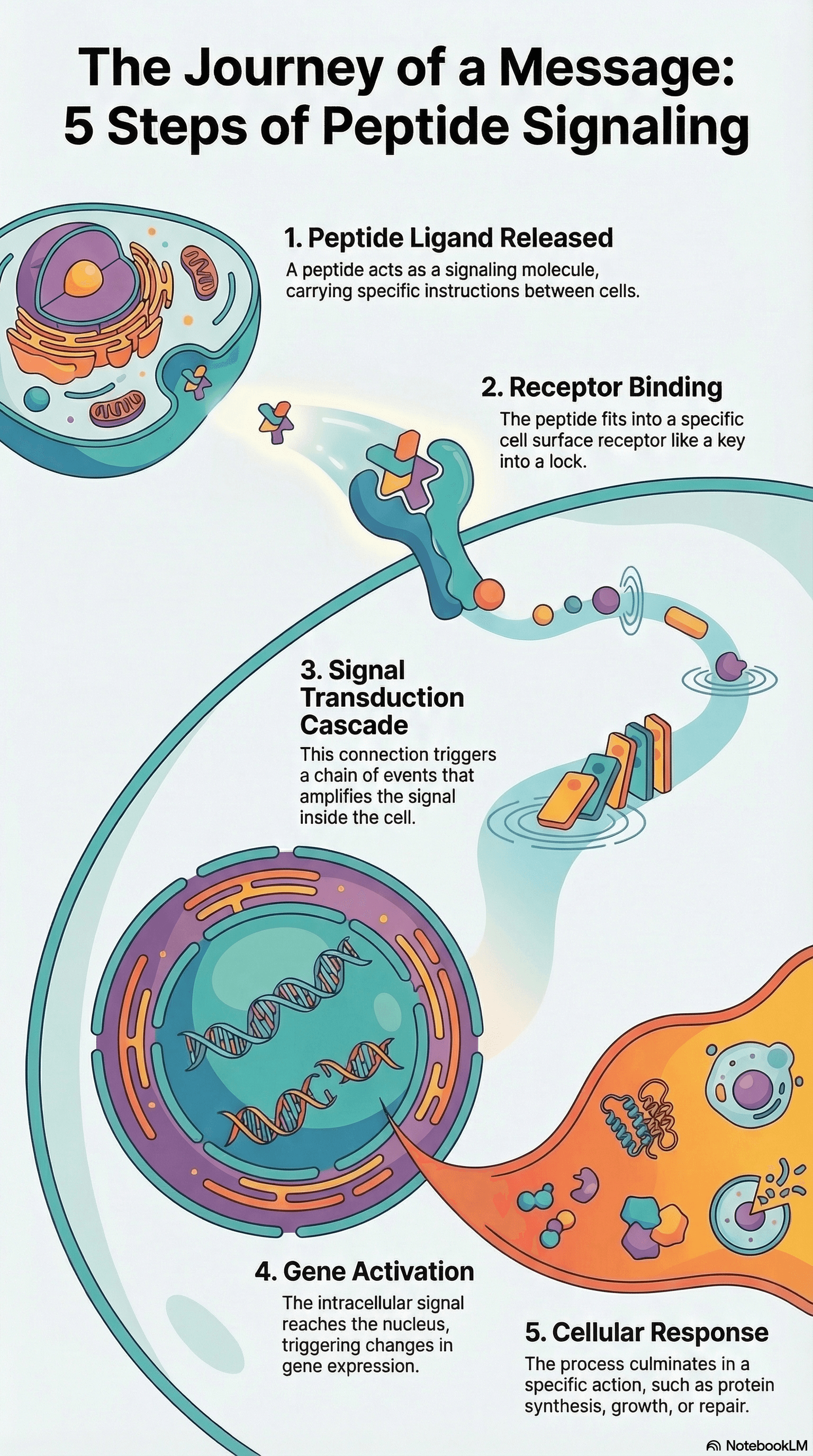
Peptide signaling begins when a peptide binds to a specific receptor on a cell surface. That interaction activates a chain of intracellular signals that can influence gene expression, protein production, and cellular behavior.
Did You Know?
- Peptides are short chains of 2 to 50 amino acids that act as signaling messengers.
- A peptide must fit its receptor with high specificity, like a key fitting a lock.
- Once a peptide binds, it can trigger a signaling cascade inside the cell.
- Some peptides, such as MOTS-C, are produced inside mitochondria and studied for energy-related signaling.
These cascades amplify the original signal and translate it into a specific cellular response — changes in gene expression, protein production, or cell behavior. The major signaling pathways researchers study include MAPK/ERK, PI3K/Akt, and cAMP signaling, each controlling different aspects of how cells grow, repair, and adapt.
What makes peptide research valuable is specificity: each peptide interacts with particular receptors in particular ways, producing distinct downstream effects. Even changing a single amino acid in a peptide's sequence can alter which receptors it binds and which pathways it activates. For a detailed look at these mechanisms, see Peptide Mechanisms Explained.
Examples of Signaling Peptides
Each research peptide interacts with different receptor systems and activates different signaling pathways. Here are five of the most actively studied compounds and why researchers work with them.
BPC-157
Researchers study BPC-157 for its interactions with tissue repair signaling — including VEGF, nitric oxide, and growth factor pathways involved in blood vessel formation and matrix rebuilding.
View research profile →Semax
Semax is studied for its effects on brain-derived neurotrophic factor (BDNF) and related growth factors that support neuronal survival, synaptic plasticity, and circuit adaptation.
View research profile →Selank
Selank is investigated for its interactions with the GABA system, enkephalin metabolism, and the intersection of inhibitory neurotransmission and immune signaling.
View research profile →MOTS-C
MOTS-C is a mitochondrial-derived peptide studied for its activation of AMPK — the cell's master energy sensor — and its role in retrograde mitochondrial signaling.
View research profile →PT-141
PT-141 selectively activates MC3R and MC4R melanocortin receptors. Researchers use it to study biased agonism — how the same receptor can trigger different downstream effects.
View research profile →Browse all compounds in the Research Hub or explore organized categories in Types of Peptides.
Key Takeaways
- Peptides are short amino acid chains that act as signaling molecules — carrying instructions between cells by binding to specific receptors.
- Signaling starts when a peptide binds a receptor, triggering intracellular cascades (MAPK/ERK, PI3K/Akt, cAMP) that change gene expression and cell behavior.
- Specificity is key — each peptide's amino acid sequence determines which receptors it binds and which pathways it activates.
- Research peptides span multiple categories: tissue signaling (BPC-157, GHK-Cu), neuropeptides (Semax, Selank), metabolic (MOTS-C), and melanocortin (PT-141, Melanotan II).
- Synthetic research peptides are manufactured at 98%+ purity, enabling controlled, reproducible experiments across a wide range of signaling pathways.
Continue Reading
All information presented in this article references published research literature and is intended for educational purposes only. Research peptides are sold strictly for laboratory research use and are not approved for human consumption or medical treatment.