Copper-Peptide Biochemistry: Structure and Metal Coordination
Among the most distinctive research peptides are those that form stable complexes with metal ions — and copper-peptide complexes occupy a unique position at the intersection of inorganic chemistry and biological signaling.
Copper-peptide complexes represent a class of biologically relevant molecules in which a peptide sequence coordinates a copper ion through specific amino acid residues. The most extensively studied copper-peptide complex is GHK-Cu, in which the tripeptide glycyl-L-histidyl-L-lysine forms a high-affinity chelate with copper(II) ions. The coordination geometry involves the imidazole nitrogen of histidine, the alpha-amino group of glycine, and the deprotonated amide nitrogen of the Gly-His peptide bond.
GHK-Cu was first identified in human plasma by Loren Pickart in 1973 during research investigating factors that influenced the behavior of hepatocytes from aged tissue compared to younger tissue. Subsequent characterization revealed that the tripeptide is present in plasma, saliva, and urine at concentrations that decline with age, an observation that has generated considerable research interest regarding its potential signaling roles.
The copper ion within the GHK-Cu complex is not merely a structural component but is functionally relevant to many of the compound's documented biological activities. Copper serves as an essential cofactor for numerous enzymes involved in extracellular matrix metabolism, including lysyl oxidase (which catalyzes collagen and elastin cross-linking), superoxide dismutase (which participates in oxidative stress defense), and cytochrome c oxidase (which functions in mitochondrial electron transport).
The ability of GHK to deliver copper ions to tissues and cells has been proposed as one mechanism through which this peptide complex may influence matrix remodeling and tissue repair processes. For additional context on how peptide signaling mechanisms operate at the molecular level, the Peptide Mechanisms Explained guide provides foundational information relevant to understanding copper-peptide interactions.
Collagen Synthesis and Post-Translational Processing
One of the most well-documented areas of GHK-Cu research involves its interactions with collagen biosynthesis — the complex process through which the body's most abundant structural protein is produced and assembled.
Collagen is the most abundant structural protein in mammalian tissues, comprising approximately 30% of total body protein. At least 28 distinct collagen types have been identified, with types I, II, and III being the most prevalent in connective tissues. Collagen biosynthesis involves a complex series of intracellular and extracellular events that transform precursor polypeptides into mature, cross-linked fibrils capable of providing structural support.
The intracellular phase of collagen synthesis begins with transcription of collagen genes and translation of procollagen alpha chains on ribosomes of the rough endoplasmic reticulum. These nascent chains undergo extensive post-translational modifications, including hydroxylation of specific proline and lysine residues by prolyl 4-hydroxylase and lysyl hydroxylase, respectively. Prolyl hydroxylation is essential for the thermal stability of the collagen triple helix, while lysyl hydroxylation provides sites for subsequent glycosylation and cross-linking.
Following triple helix assembly, procollagen molecules are secreted into the extracellular space, where N- and C-terminal propeptides are cleaved by specific procollagen proteinases. The resulting tropocollagen molecules spontaneously assemble into fibrils, which are then stabilized through covalent cross-links formed by the copper-dependent enzyme lysyl oxidase.
Research has documented that GHK-Cu influences multiple steps in the collagen biosynthetic pathway. Published studies have reported increased expression of type I and type III collagen mRNAs in fibroblast cultures treated with GHK-Cu. Additionally, the copper delivered by the GHK-Cu complex may support lysyl oxidase activity, potentially enhancing the cross-linking and maturation of newly synthesized collagen fibrils.
Matrix Metalloproteinase Regulation and ECM Remodeling
Matrix metalloproteinases (MMPs) are a family of zinc-dependent endopeptidases that collectively degrade all components of the extracellular matrix. More than 20 MMP family members have been identified in humans, classified into subgroups including collagenases (MMP-1, -8, -13), gelatinases (MMP-2, -9), stromelysins (MMP-3, -10, -11), and membrane-type MMPs (MT-MMPs). The activity of MMPs is regulated at multiple levels, including transcription, proenzyme activation, and inhibition by tissue inhibitors of metalloproteinases (TIMPs).
The balance between MMPs and TIMPs is a critical determinant of ECM turnover rate. Under normal homeostatic conditions, this balance maintains tissue architecture through controlled cycles of matrix degradation and synthesis. Disruption of MMP/TIMP balance, with excessive MMP activity, has been documented in pathological tissue remodeling, while insufficient MMP activity can impair normal tissue repair processes that require matrix reorganization.
Published research on GHK-Cu has documented complex effects on the MMP/TIMP system. Studies have reported that GHK-Cu treatment modulated the expression of both MMPs and TIMPs in fibroblast and tissue models, with the net effect depending on experimental context. In some models, GHK-Cu increased TIMP-1 expression while reducing certain MMP levels, suggesting a shift toward matrix preservation. In tissue repair models, observations suggested that GHK-Cu supported the controlled matrix remodeling necessary for organized tissue reconstruction.
These findings illustrate the context-dependent nature of ECM regulation and highlight why GHK-Cu has attracted interest as a research tool for studying matrix dynamics. The interplay between MMP regulation and vascular remodeling is explored further in the article on Angiogenesis Signaling, where matrix degradation plays an essential role in new vessel formation.
GHK-Cu in Wound Healing Research Models
Wound healing is a complex, multi-phase process that proceeds through overlapping stages of hemostasis, inflammation, proliferation, and remodeling. Each phase involves coordinated signaling between multiple cell types, including platelets, immune cells, fibroblasts, keratinocytes, and endothelial cells. The extracellular matrix serves as both a substrate for cell migration and a reservoir of growth factors that are released through proteolytic remodeling during the healing process.
GHK-Cu has been examined in numerous preclinical wound healing models. Published studies using full-thickness wound models have documented observations of accelerated wound closure, increased granulation tissue formation, and enhanced collagen deposition in GHK-Cu-treated groups compared to controls. Histological analyses have reported more organized collagen fiber architecture in treated wounds, suggesting effects on matrix remodeling quality in addition to quantity.
Research has also documented that GHK-Cu influenced the expression of decorin, a small leucine-rich proteoglycan that regulates collagen fibril assembly and growth factor signaling. Decorin has been identified as a critical modulator of organized collagen deposition, and its upregulation by GHK-Cu has been proposed as one mechanism through which the peptide complex may influence tissue remodeling outcomes in research models.
Additional studies have examined GHK-Cu effects on glycosaminoglycan synthesis, documenting increased production of chondroitin sulfate, dermatan sulfate, and heparan sulfate in treated tissue models. These proteoglycans contribute to the hydration, mechanical properties, and growth factor-binding capacity of healing tissues. Collectively, the wound healing literature positions GHK-Cu as a multifaceted modulator of tissue repair signaling that interacts with multiple components of the regenerative cascade.
Gene Expression Profiling: GHK-Cu's Broad Transcriptomic Signature
Large-scale gene expression analyses have provided a comprehensive view of GHK-Cu's signaling reach at the transcriptomic level. A landmark study by Pickart and colleagues analyzed the effects of GHK-Cu on gene expression using the Broad Institute's Connectivity Map database, which contains gene expression profiles from human cell lines treated with various bioactive compounds.
This analysis documented that GHK-Cu significantly modulated the expression of 4,096 genes in human cell lines, representing approximately 32% of the genes assessed. The affected genes clustered into functional categories including extracellular matrix organization, antioxidant defense, DNA repair, ubiquitin-proteasome pathways, insulin and growth factor signaling, and immune response modulation.
The breadth of this transcriptomic signature was notable and suggested that GHK-Cu interacts with fundamental cellular regulatory networks rather than a single isolated pathway.
Among the most significantly upregulated genes were those encoding collagen types and ECM components, consistent with the compound's documented effects on matrix synthesis. Simultaneously, genes associated with oxidative stress and inflammatory signaling showed patterns of downregulation, suggesting coordinated effects across multiple functional programs.
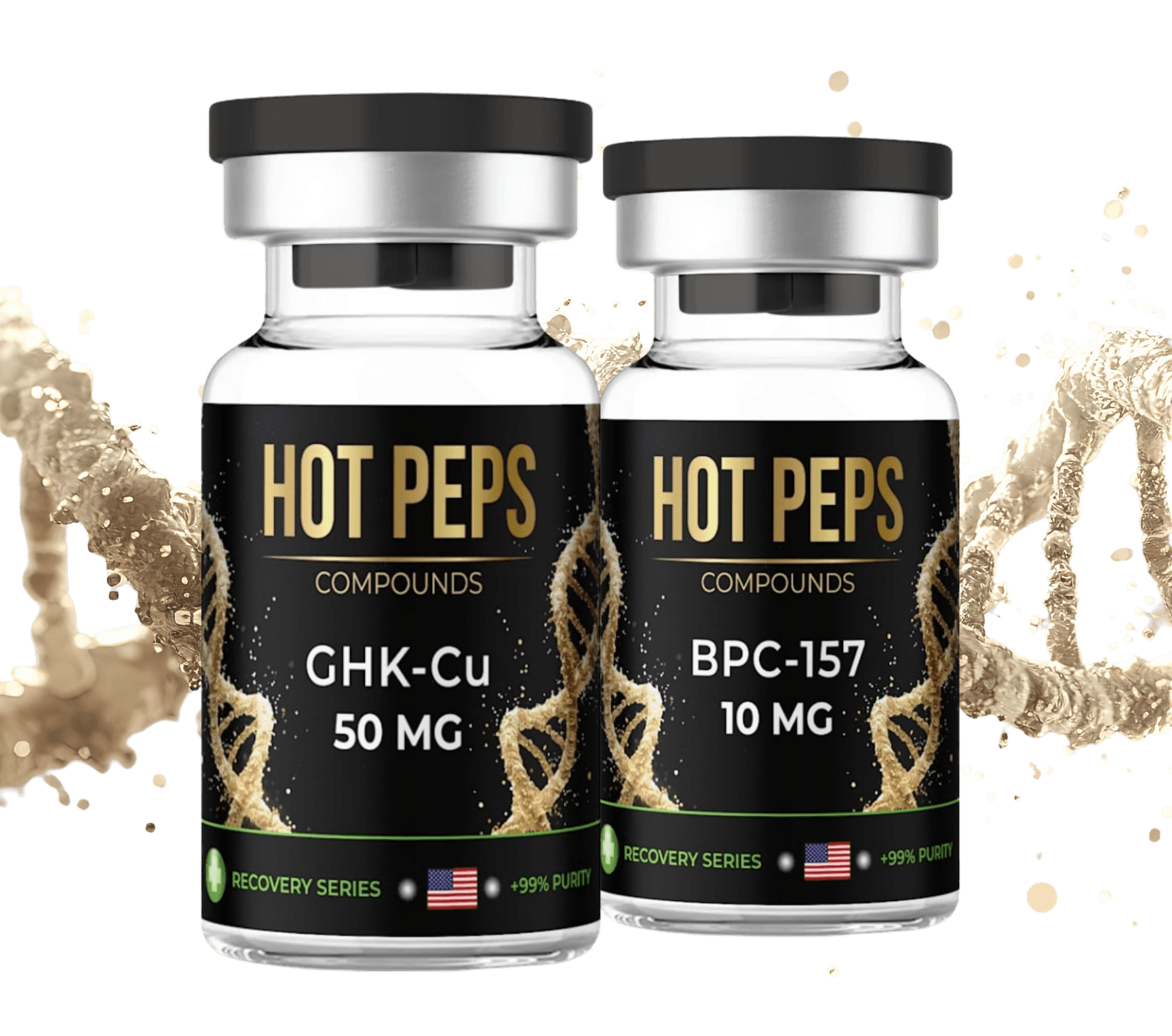
These gene expression data have informed hypotheses about GHK-Cu's mechanisms of action and have guided the design of focused research investigations. The finding that a simple tripeptide-copper complex can influence such a large number of genes has raised questions about the molecular pathways through which GHK-Cu signals. Current hypotheses include direct effects of copper delivery on metalloenzyme activity, integrin-mediated signaling triggered by GHK binding, and potential interactions with cell-surface receptors yet to be fully characterized. The Recovery Stack includes GHK-Cu alongside complementary research compounds for investigators studying tissue remodeling pathways.
Related Compounds
Continue Exploring the Science
Compound Research Kits

All information presented in this article references published research literature and is intended for educational purposes only. Research peptides are sold strictly for laboratory research use and are not approved for human consumption or medical treatment.